Adrenal Tumours: Symptoms, Diagnosis & When Surgery is Needed
Hello Reader!
Welcome to the blog page of Dr Suman Sahoo, the best uro-oncologist in Medinipur.
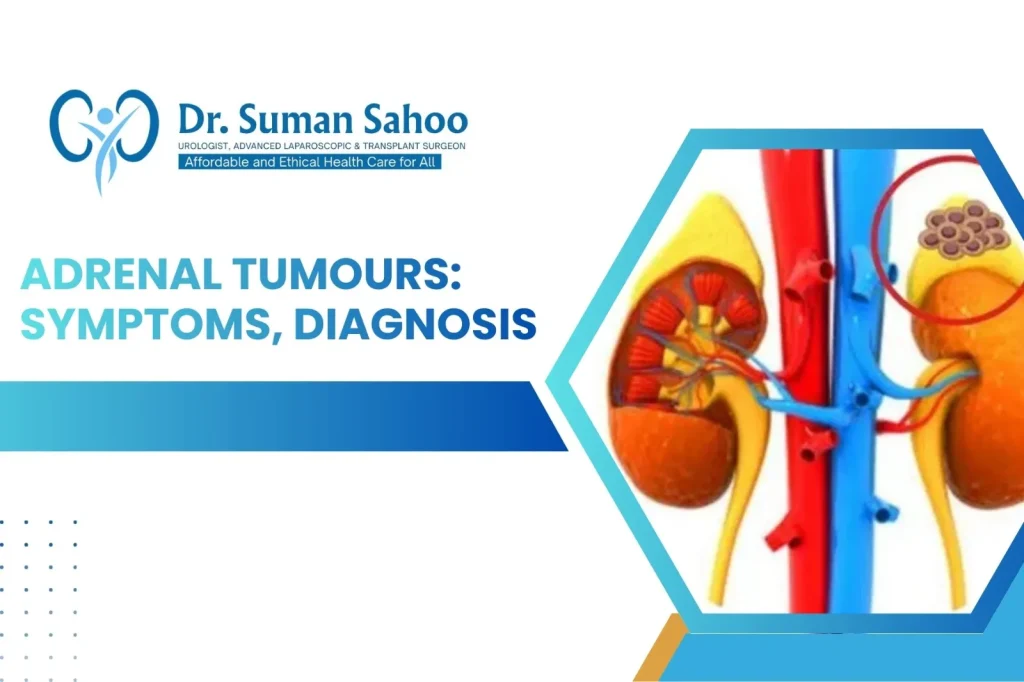
Adrenal glands are small, triangular organs located on top of each kidney. Despite their size, they play a powerful role in regulating hormones like cortisol, adrenaline, and aldosterone. When abnormal growths develop in these glands, they are known as Adrenal Tumours. These tumours can cause hormonal imbalances and serious health issues if not diagnosed and treated on time.
As the Best Uro Oncologist in Medinipur, Dr Suman Sahoo frequently evaluates and treats patients with adrenal-related disorders, offering advanced diagnostic tools and highly successful treatment options. This blog explains the symptoms, diagnosis, and when surgery becomes necessary for Adrenal Tumours.

What Are Adrenal Tumours?
Adrenal Tumours are abnormal growths in one or both adrenal glands. They can be:
- Benign (non-cancerous) – such as adenomas
- Malignant (cancerous) – such as adrenocortical carcinoma
- Hormone-producing – causing excessive hormone release
- Non-functioning – not producing hormones
The impact of Adrenal Tumours depends on their size, location, and whether they create hormonal disturbance.
Common Symptoms of Adrenal Tumours
The symptoms vary widely depending on whether the tumour is functional (producing hormones) or non-functional.
1. Symptoms of Functional Adrenal Tumours
Functional tumours produce excess hormones and lead to:
Cortisol-producing tumours (Cushing’s syndrome):
- Rapid weight gain
- Rounding of the face
- High blood pressure
- Diabetes
- Muscle weakness
Aldosterone-producing tumours (Conn’s syndrome):
- Persistent high blood pressure
- Low potassium levels
- Muscle cramps
- Excessive thirst
Adrenaline-producing tumours (Pheochromocytoma):
- Severe headaches
- Palpitations
- Sweating
- Panic attack–like episodes
2. Symptoms of Non-Functional Adrenal Tumours
These may not produce hormones but cause symptoms due to size:
- Abdominal pain
- Back pressure
- Unexplained fatigue
- Feeling of fullness
If you experience any of these symptoms, consulting an expert like the Best Uro Oncologist in Medinipur ensures early detection and improved outcomes.
Also Read: Kidney Cancer: Risk Factors, Screening & Treatment Options

How Are Adrenal Tumours Diagnosed?
A systematic diagnostic approach is essential to understand the nature of the tumour and the best treatment option.
1. Blood and Urine Hormone Tests
These tests measure hormone levels such as cortisol, aldosterone, and adrenaline to detect hormonal imbalances.
2. Imaging Tests
To identify and locate the tumour:
- CT Scan
- MRI Scan
- PET Scan (for suspected cancer)
Advanced scanning helps determine whether the tumour is benign or malignant.
3. Adrenal Venous Sampling (AVS)
This test is done in selective hormone-producing tumours to identify which adrenal gland is affected.
4. Biopsy (Rarely Done)
Usually avoided unless cancer metastasis is suspected, as biopsy can sometimes trigger hormone release.
Accurate diagnosis by the Best Uro Oncologist in Medinipur ensures the right line of treatment, whether medical, surgical, or observation-based.

When Is Surgery Needed for Adrenal Tumours?
Not all Adrenal Tumours require surgery. Surgery becomes necessary when:
1. The Tumour Is Hormone-Producing
Functional tumours almost always require removal because excess hormones can be life-threatening.
2. Tumour Is Large
Any adrenal tumour larger than 4–6 cm is at risk of being cancerous and usually requires surgical removal.
3. Suspicion of Cancer
If imaging suggests malignancy, surgery is recommended immediately.
4. Pheochromocytoma
These tumours release dangerous hormones and can cause hypertensive emergencies. Surgical removal is the definitive treatment.
5. Rapid Tumour Growth
A tumour that grows significantly over time is considered risky and is typically removed.
Types of Adrenal Surgery
The Best Uro Oncologist in Medinipur often recommends advanced techniques such as:
- Laparoscopic adrenalectomy (minimally invasive)
- Robotic adrenalectomy
- Open adrenalectomy (for very large or cancerous tumours)
The choice of procedure depends on tumour size, type, and overall patient health.

Complications and Risks of Adrenal Tumour Surgery
Perioperative Complication Rates
Adrenalectomy complication rates vary widely from 1.7% to over 30%, depending on factors like tumour size, type, and surgical approach. Laparoscopic surgery generally has fewer complications compared to open surgery.
Common Surgical Risks
- Bleeding during or after surgery
- Injury to nearby organs such as colon, spleen, pancreas, and diaphragm
- Infection risks at the surgical site
- Blood clots leading to deep vein thrombosis or pulmonary embolism
Risks Specific to Hormone-Producing Tumours
For pheochromocytoma, risks include hypertensive or hypotensive crises during surgery, which can be life-threatening. Patients with Cushing’s syndrome are prone to metabolic complications, poor wound healing, and blood clotting disorders post-surgery.
Postoperative Risks
- Pneumonia and respiratory complications, especially after open surgery
- Hormonal imbalances due to adrenal insufficiency may require hormone replacement therapy
- Pain and prolonged recovery time, with some patients needing conversion to open surgery in case of complications
Factors Increasing Complication Risk
- Larger tumour size and malignancy (e.g. adrenocortical carcinoma)
- Older age and multiple comorbidities
- Bilateral adrenalectomy carries higher risks than unilateral surgery
Choosing the Best Uro Oncologist in Medinipur ensures careful preoperative evaluation and expert surgical management to minimize these risks and improve patient outcomes.

Diagnostic Tests for Adrenal Tumours: Blood Tests and Imaging
Diagnostic evaluation of adrenal tumours is comprehensive, combining blood tests and various imaging modalities to accurately identify and characterize the tumour for optimal treatment planning.
Blood and Urine Tests
- Hormonal Assays: Blood and urine samples are analyzed to measure levels of adrenal hormones, including cortisol, aldosterone, catecholamines (epinephrine, norepinephrine), and their metabolites like metanephrines. These tests detect hormone overproduction indicative of functional adrenal tumours such as Cushing’s syndrome, Conn’s syndrome, and pheochromocytoma.
- Electrolyte Levels: Testing potassium and renin activity helps diagnose aldosterone-secreting tumours (Conn’s syndrome).
- 24-Hour Urine Collection: Used for quantifying cortisol and catecholamines metabolites to evaluate hormone secretion comprehensively over time.
Imaging Studies
- Computed Tomography (CT) Scan: The primary imaging method providing detailed cross-sectional images of adrenal glands to assess tumour size, location, and characteristics (benign versus malignant features) and detecting local invasion or spread.
- Magnetic Resonance Imaging (MRI): Offers additional tissue characterization and helps evaluate lipid content distinguishing benign adenomas from malignancies; also used when CT contrast is contraindicated.
- Positron Emission Tomography (PET) Scan: Used selectively to assess the metabolic activity of the tumour and detect distant metastases in malignant cases.
- Adrenal Vein Sampling: An interventional radiology procedure to sample hormone levels directly from adrenal veins, especially useful to differentiate unilateral from bilateral aldosterone production in Conn’s syndrome.
Post-Surgery Recovery & Follow-Up
Recovery after adrenal surgery is usually smooth, especially with minimally invasive approaches. Most patients can return to normal activities within 1–2 weeks. Regular follow-ups are essential to:
- Monitor hormone levels
- Check for tumour recurrence
- Adjust medications if needed
Choosing an experienced surgeon like the Best Uro Oncologist in Medinipur ensures safe surgery and optimal recovery.
Role of Biopsy in Confirming Tumour Type
The role of biopsy in confirming adrenal tumour type is primarily to provide a definitive tissue diagnosis when imaging and laboratory tests alone cannot adequately characterize the adrenal mass. Image-guided biopsy, such as CT-guided or ultrasound-guided needle biopsy, is a safe and established technique that helps differentiate between benign and malignant adrenal lesions, especially when suspicion exists for metastatic disease or unknown primary tumors.
Biopsy is particularly useful in patients with multiple malignancies where it is necessary to confirm if the adrenal mass represents metastasis or a primary adrenal tumour. It can also help distinguish adrenal cortical carcinoma from other adrenal masses when imaging results are equivocal. However, with advances in specialized adrenal CT and MRI protocols, non-invasive imaging methods now reliably diagnose many benign adrenal adenomas, reducing the need for biopsy in such cases.
Despite being a valuable diagnostic tool, biopsy has limitations including a small risk of tumor seeding along the needle track and bleeding. Its use is generally avoided if the clinical indication for surgical removal is clear or if the tumour is hormonally active, such as pheochromocytoma or cortisol-producing tumours. The decision to perform biopsy is carefully made by specialists like the Best Uro Oncologist in Medinipur after comprehensive evaluation.
In summary, biopsy plays a key role in confirming tumour pathology in complex or unclear cases where imaging does not conclusively differentiate benign from malignant adrenal tumours, guiding appropriate management and treatment planning.

Hormone-Producing vs Non-Functional Tumours
Hormone-producing adrenal tumours are functional tumours that secrete excess hormones, which can cause a variety of symptoms related to the specific hormone produced. These tumours arise from the adrenal cortex or medulla and can produce hormones such as cortisol, aldosterone, adrenaline, or sex hormones. For example, cortisol-producing tumours may cause Cushing’s syndrome, characterized by weight gain, hypertension, muscle weakness, and skin changes. Aldosterone-producing tumours can lead to primary aldosteronism, resulting in high blood pressure and low potassium levels. Tumours producing excess sex hormones might cause symptoms like abnormal hair growth or breast enlargement, depending on the hormone and the patient’s sex. These hormone imbalances often necessitate treatment due to their systemic effects.
Non-functional adrenal tumours, in contrast, do not produce excess hormones and typically do not cause hormone-related symptoms. These tumours are often discovered incidentally during imaging for unrelated reasons and might remain asymptomatic for a long time. Because they do not disrupt hormone balance, they may not require immediate intervention unless they grow large or exhibit features suspicious for malignancy. Non-functional tumours are much more common than hormone-producing tumours. However, monitoring is required because some non-functional tumours can eventually begin producing hormones or grow significantly.
In summary, the key difference is that hormone-producing (functional) adrenal tumours actively secrete hormones leading to clinical symptoms and systemic effects, thus often prompting earlier treatment such as surgery. Non-functional tumours do not affect hormone levels and are usually managed conservatively unless they show signs of growth or malignancy. As the Best Uro Oncologist in Medinipur, distinguishing between these types guides appropriate diagnostic evaluation and treatment planning for optimal patient care.
Hormonal Effects and Related Clinical Signs
Hormonal effects caused by adrenal tumours vary depending on the type of hormone the tumour produces in excess. As the Best Uro Oncologist in Medinipur, Dr Suman Sahoo explains, these hormonal imbalances lead to specific clinical signs that help in diagnosis:
- Excess Cortisol (Cushing’s Syndrome)
Symptoms include persistent high blood pressure, obesity with characteristic fat deposits in the abdomen, face (moon face) and upper back (buffalo hump), muscle weakness, purple stretch marks, easy bruising, mood changes like depression, irregular menstrual cycles, and increased facial/body hair in women. - Excess Aldosterone (Conn’s Syndrome)
Leads to hypertension difficult to control with medication, low potassium causing muscle cramps, fatigue, headaches, palpitations, and increased urination due to electrolyte imbalance. - Excess Androgens (Male Sex Hormones)
Women may experience virilization symptoms such as excessive facial/body hair, deepened voice, acne, menstrual irregularities. In children, androgen excess can cause early puberty signs. - Excess Estrogens (Female Sex Hormones)
May cause breast enlargement in men, sexual dysfunction, testicular shrinkage, and in girls, early puberty or breast development. - Excess Adrenaline (Pheochromocytoma)
Tumours of the adrenal medulla cause excessive adrenaline secretion, leading to symptoms like episodic high blood pressure, sweating, palpitations, headaches, tremors, and anxiety attacks.

FAQ
1. What are adrenal tumours?
Adrenal tumours are abnormal growths that develop in the adrenal glands located above the kidneys. They can be benign (non-cancerous) or malignant (cancerous).
2. What common symptoms indicate an adrenal tumour?
Symptoms may include high blood pressure, weight gain, excessive sweating, fatigue, headaches, and unexplained mood changes. Some tumours may also cause hormonal imbalances.
3. Can adrenal tumours exist without symptoms?
Yes. Many adrenal tumours are discovered incidentally during scans for unrelated issues and may not cause noticeable symptoms.
4. How are adrenal tumours diagnosed?
Diagnosis typically includes blood and urine tests to check hormone levels, along with imaging tests such as CT scans or MRI to identify the size and nature of the tumour.
5. When should I consult a doctor for possible adrenal tumour symptoms?
If you experience persistent high blood pressure, unexplained weight changes, hormone-related issues, or symptoms that do not improve with regular treatment, you should seek medical evaluation.
Final Thoughts
Adrenal Tumours can lead to significant health issues if left untreated. Recognising symptoms early, getting an accurate diagnosis, and consulting a specialist are the keys to better outcomes. Surgical treatment is highly effective, especially when performed by someone with expertise in uro-oncology and endocrine tumours.
If you or your family member is experiencing symptoms related to adrenal gland problems, seek expert evaluation from Dr. Suman Sahoo, the Best Uro Oncologist in Medinipur, to get the right diagnosis and world-class treatment.
Recent Posts


Should You Get a PSA Test Before It’s Too Late?
February 24, 2026